1929 to today

Two schools, one family.

Dunbar and Horace Mann on the south side of Little Rock, the poet one of them is named for, and the alumni who keep both alive. The story is told below, and thirteen milestones follow. Every line is sourced.

Dunbar, 1929

The school on Wright Avenue

Little Rock finished a new high school for white students in 1927. School Board member G. DeMatt Henderson, Sr., believed the city's Black students deserved one too. He traveled to Chicago at his own expense and won a grant from Julius Rosenwald, the Sears, Roebuck and Co. executive whose fund helped build nearly 5,000 schools for Black children across the South. Most Rosenwald schools have vanished or stand empty today. Dunbar is one of the few still teaching, first as a segregated school, then an integrated one, and now a magnet school.

The building opened in 1929 as the Negro School of Industrial Arts and was dedicated on April 14, 1930. It was a junior and senior high school with general education, trade classes, and college preparatory courses, and Dunbar Junior College occupied one wing. Families from every corner of Arkansas sent their children to live with relatives or friends in Little Rock so they could study here.

On the faculty was Charlotte Andrews Stephens, the first Black teacher in Little Rock, who served the city's schools for sixty years and worked at Dunbar as librarian and occasional teacher of English and Latin before she retired. A modern building, a strong faculty, and a demanding curriculum earned Dunbar accreditation from the North Central Association in 1931, a distinction most white schools in the state did not yet hold.
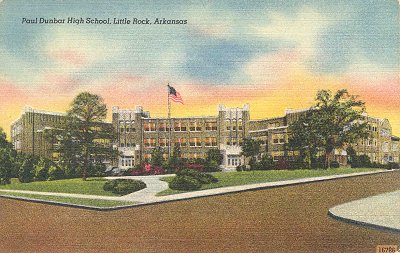
A tinted postcard of Paul Laurence Dunbar High School, a long brick building with a flag flying in front
Paul Laurence Dunbar High School on a linen postcard. [CONFIRM: postcard source and permission]

One city block, then six

Sanborn fire insurance maps show Dunbar rising on the same block as the old Gibbs High School. Gibbs stood at 18th and Ringo, and Dunbar took the corner of Wright and Ringo. The old Gibbs Elementary School sat just to the west, about where the Dunbar gymnasium stands now, and the old high school was still standing as late as 1939. Over the years six city blocks between Cross and Chester streets, from 16th Street to Wright Avenue, were joined into one campus. It now holds Dunbar, the present Gibbs Elementary School, the Dunbar Community Center, the Dunbar Community Garden, athletic fields, and the Sue Cowan Williams Library, named for the Dunbar teacher whose story comes next.

A Dunbar teacher takes on the school district

By the 1940s Black teachers in Little Rock were paid far less than white teachers for the same work. Susie Morris, chair of the English department at Dunbar, agreed to be the plaintiff. With Thurgood Marshall of the NAACP and Little Rock attorneys Scipio A. Jones and J. R. Booker, she sued the Little Rock School District for equal pay in 1942. She lost at trial, and the district declined to renew her contract. In 1945 the Eighth Circuit Court of Appeals reversed that decision. She married and became Sue Cowan Williams, and the library beside the school carries her name. Booker Arts Magnet Elementary is named for her attorney J. R. Booker, and the association's own work to restore the Scipio A. Jones house on South Cross Street honors the other.

Horace Mann, 1956

A second school, and a hard decade

When Horace Mann High School opened on April 9, 1956, Dunbar's high school students moved to the new campus and Dunbar became a junior high. The $926,000 building was recognized by the American Institute of Architects. The next year six of the Little Rock Nine transferred from Horace Mann to Central High School. In 1958 Governor Faubus closed every public high school in the city for a full year, and Horace Mann's students lost that year with everyone else. Horace Mann graduated its last senior class in 1965 and became a junior high in turn. Its Transitional Class of 1972 marks the change.

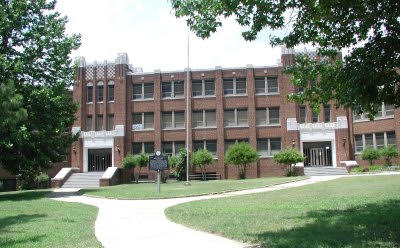
The front of the Dunbar building today, three stories of brick with a historical marker on the lawn
The same front doors, with the historical marker on the lawn. [CONFIRM: photo source and permission]

Still teaching on Wright Avenue

Additions came in 1952, in 1965 and 1966, and in 1969. The National Register of Historic Places listed the school in 1980. Dunbar became a magnet school in 1990 with a program in international studies and a program for gifted and talented students. A major renovation finished in 2004 restored the classrooms, rebuilt the gymnasium, and added a new media center, and that same year Magnet Schools of America named Dunbar a Magnet School of Distinction.

Inside the school, the association's Memorabilia Room keeps artifacts and memories from Dunbar's early years. [CONFIRM: Memorabilia Room still maintained] The alumni who gather there, and in chapters across the country, are dedicated to carrying the Dunbar spirit of excellence into their own lives and the lives of others, and to preserving this history for the generations that follow.

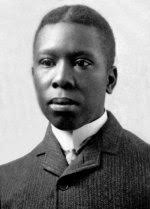
Portrait of Paul Laurence Dunbar as a young man in a dark suit and high collar
Paul Laurence Dunbar. Library of Congress, America's Library.
The name

Paul Laurence Dunbar, 1872 to 1906

Paul Laurence Dunbar was born in Dayton, Ohio, to parents who had been enslaved. His mother Matilda worked for a time for the family of Orville and Wilbur Wright, and Paul attended Dayton's Central High School alongside Orville. He was the only Black student in his class. He joined the debating society, edited the school paper, and was elected president of the literary society. With help from the Wright brothers he published a newsletter for Dayton's Black community, the Dayton Tattler.

"The most promising young colored man in America."

Frederick Douglass, after hearing Dunbar recite at the 1893 World's Fair

He gave his first public reading on his birthday in 1892, the year his first collection, Oak and Ivy, appeared. His second book, Majors and Minors, drew praise from William Dean Howells in Harper's Weekly and carried his name into the country's leading literary circles. Dodd, Mead and Company combined the two books as Lyrics of Lowly Life, and in 1897 he read his work on the London literary circuit. He came home to a post at the Library of Congress, left it after a year to write and recite full time, and kept working as tuberculosis wore him down.

By his death at 33 he had produced twelve books of poetry, four collections of short stories, a play, and five novels, and had become the first Black poet to gain worldwide recognition. When Little Rock's new school needed a name in 1930, it chose his.

The milestones

Thirteen dates, 1929 to today

  1. 1929

    A school rises on Wright Avenue

    School Board member G. DeMatt Henderson travels to Chicago at his own expense to win a grant from Julius Rosenwald. Built at Wright Avenue and Ringo Street with $67,000 from the Rosenwald Fund, $30,000 from the General Education Board, and money raised locally, the school opens as the Negro School of Industrial Arts.

    Source: Encyclopedia of Arkansas; school history supplied by the association
  2. 1930

    Renamed for Paul Laurence Dunbar

    Dedicated April 14, 1930 as Paul Laurence Dunbar High School, with 1,163 high school students and 74 junior college students. The first graduating class numbers 58.

    Source: Encyclopedia of Arkansas
  3. 1931

    Accredited by the North Central Association

    Two years after opening, Dunbar earns accreditation from the North Central Association of Colleges and Schools. Most white high schools in Arkansas did not hold it at the time.

    Source: school history supplied by the association
  4. 1945

    A Dunbar teacher wins equal pay

    Susie Morris, chair of Dunbar's English department, sues the Little Rock School District for pay equal to white teachers, with Thurgood Marshall, Scipio A. Jones, and J. R. Booker as counsel. She loses at trial. The Eighth Circuit Court of Appeals rules in her favor in 1945.

    Source: Encyclopedia of Arkansas, Sue Cowan Williams; school history supplied by the association
  5. 1956

    Horace Mann High School opens

    Students move into the new Horace Mann High School on April 9, 1956. The $926,000 campus is recognized by the American Institute of Architects. Dunbar becomes a junior high.

    Source: Encyclopedia of Arkansas; archived ndhmaa.com
  6. 1957

    The Little Rock Nine

    Six of the Little Rock Nine, Ernest Green, Elizabeth Eckford, Thelma Mothershed, Terrence Roberts, Minnijean Brown, and Melba Pattillo, transfer from Horace Mann to Central High School.

    Source: Wikipedia, Horace Mann Senior High School
  7. 1958

    The Lost Year

    Governor Faubus closes every public high school in Little Rock for the 1958 to 1959 school year, Horace Mann included. Of 750 Black high school students, 442 do not attend school that year.

    Source: archived ndhmaa.com; The Lost Year Project
  8. 1965

    Horace Mann graduates its final senior class

    After ten years as a high school, Horace Mann becomes a junior high. The Transitional Class of 1972 marks the change.

    Source: Wikipedia, Horace Mann Senior High School
  9. 1973

    The first Reunion of the Classes

    Dunbar alumni gather in Detroit in August 1973 for the first all class reunion. The National Dunbar Alumni Association is chartered in Arkansas in June 1978.

    Source: History of the National Dunbar Alumni Association, Dr. Erma Glasco Davis
  10. 1980

    Dunbar joins the National Register of Historic Places

    Listed August 6, 1980. In February 2026 the building is redesignated as nationally significant.

    Source: National Park Service; Encyclopedia of Arkansas
  11. 1990

    Dunbar becomes a magnet school

    A junior high since 1955, Dunbar reopens as a magnet school for international studies. A major renovation finished in 2004 rebuilds the gymnasium and adds a media center, and Magnet Schools of America names Dunbar a Magnet School of Distinction that year.

    Source: school history supplied by the association
  12. 2009

    Two alumni associations become one

    The Dunbar and Horace Mann alumni associations merge in July 2009, joining the two schools' alumni into a single national body.

    Source: the association's Facebook group
  13. 2024

    Sustain the Rock award

    The City of Little Rock honors NDHMAA with the Sustain the Rock award in the nonprofit category for commemorating the history of Black students in the city and for its annual scholarships.

    Source: City of Little Rock
Sources

Encyclopedia of Arkansas, Paul Laurence Dunbar High School and Sue Cowan Williams. National Park Service, Paul Laurence Dunbar High School. Wikipedia, Dunbar High School (Little Rock) and Horace Mann Senior High School. School history of Dunbar Magnet Middle School, supplied by the association. History of the National Dunbar Alumni Association by Dr. Erma Glasco Davis, as published on the association's earlier website. Central Arkansas Library System, National Dunbar Alumni Association correspondence. City of Little Rock, 2024 Sustain the Rock award winners. Portrait of Paul Laurence Dunbar from the Library of Congress, America's Library.